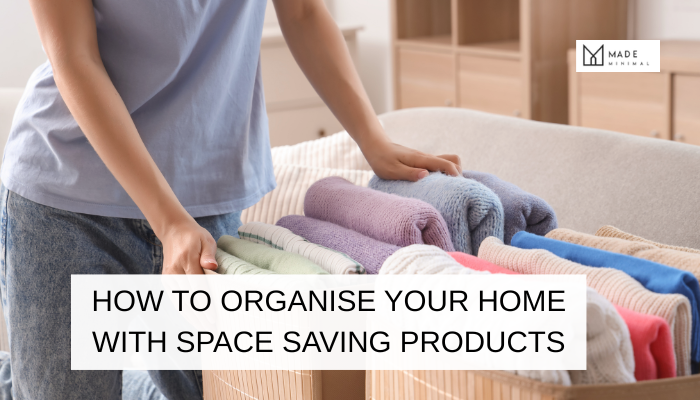
The quickest way to organise your home is to choose smarter furniture and give every item a fixed place. Most people skip such planning and go straight to buying extra storage bins, additional shelves, and even more stuff, then wonder why the clutter keeps coming back.
At Made Minimal, we often hear clients talk about making this mistake while trying to organise their homes. But often, a few well-chosen pieces and a simple storage system can change how your entire house feels to live in.
In this article, you’ll pick up practical decluttering tips, learn which furniture does double duty in smaller rooms, and find out how to build habits that actually stick.
If you’re ready to simplify your space, read on.
Home Organisation Starts with Fewer Pieces, Not More Storage
Most people buy more storage to solve clutter, but the real fix starts with owning less in the first place. That’s why adding another shelf, basket, or set of drawers never helps when the room actually needs fewer things (and honestly, a fourth storage bin just gave the mess a new address).
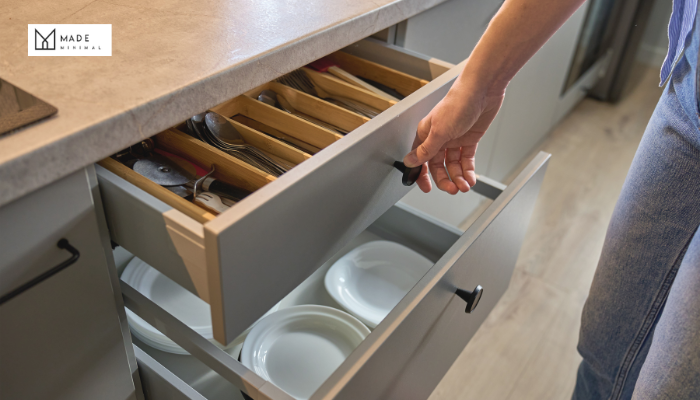
In that sense, choosing fewer, well-placed pieces reduces the visual noise in a room and makes the whole space look calmer and easier to move through. With this change, you usually notice the difference within a few days.
A minimalist home approach comes down to being honest about what you actually use, what genuinely earns its place, and letting the rest go. This simplicity usually makes the home simpler to manage.
See also: The Real Cost and Access Tradeoffs Behind gpl1 Meds
Space Saving Furniture That Actually Works in Any Room
Space-saving items work best when it pulls double duty by cutting down the number of pieces you need without leaving your home feeling empty. In practice, small rooms often struggle with limited walking space and hidden clutter. But the right furniture choices make those issues a lot easier to work around.
Before buying, these three areas are worth looking at closely:
Coffee Tables That Double as Storage
A coffee table with built-in drawers or a lift top gives your living room hidden storage without adding extra pieces. Plus, keys, books, remotes, all of it fits neatly behind a closed drawer but stays within easy reach.
Ottoman-style coffee tables take that reliability further by offering flexible seating and interior storage for kids’ toys or extra cushions. (Most people genuinely underestimate how much one furniture swap can shift the whole look of a room.)
Moreover, a coffee table with open shelving keeps books and décor accessible without adding another storage unit.
Dining Tables Built for Smaller Spaces
An extendable dining table gives you a compact everyday surface plus a full-sized table when friends come over. Wall-mounted fold-down tables work similarly and suit spaces you only use for dining occasionally, beyond just tiny apartments.
Additionally, swapping four individual chairs for a bench seat frees up a noticeable amount of floor space. Lighter colours and natural finishes further help the area feel more open.
Minimalist Home Picks That Do More with Less
From our experience working with space-saving products, removing bulky items usually improves movement and visual space more than adding extra décor. Multi-functional furniture is the clearest example of this.
In practice, one piece serving two or three purposes means fewer things competing for walking space and more room to breathe. That’s why Brisbane retailers like Made Minimal carry space-saving picks, such as wall-mounted coat hooks and drawer organisers, for rooms with tight layouts.
Neutral colours and minimal designs help too, since those pieces work in different rooms as your needs change.
Once you have the furniture sorted, your next step is to stop clutter from slowly creeping back into the room.
Simple Storage Solutions for a Home Declutter That Lasts
Getting the right pieces only solves part of the problem. You also need to notice where mess tends to collect, why it collects there, and how to store belongings in a way that feels easy to maintain long-term. And the easiest way to tackle this process is to start organising one room at a time.
Start by following these strategies:
Room-by-Room: Where Clutter Builds Up Fastest
The areas without a clear storage plan always cause frustration because people tend to dump everything there by default.
For example, entryways collect shoes and bags, kitchen benches disappear under stacks of papers and things without a proper home. Plus, bedroom floors become a catch-all for anything that doesn’t belong elsewhere.
So spotting those hotspots early makes the whole decluttering process less overwhelming. You can also try vertical storage options, like wall shelves and tall shelf units, which work well in rooms with limited floor space.
What to Keep, What to Clear Out
Decluttering gets easier when you think in categories rather than room by room. For instance, you can declutter clothes in one pass, books in another, and kitchen stuff after that. This way, seeing the full scale of what you own makes the decisions clearer.
From there, you can follow a simple rule for decluttering. Keep the item:
- You use regularly
- With genuine sentimental value
- Can serve more than one purpose
Other than these, toss the unnecessary belongings in the bin. Sometimes, letting go of a collection you’ve held onto for months is one of the more satisfying parts of the process.
Making Storage Part of Your Everyday Routine
Any storage system falls apart when people stop using it consistently. This usually happens when putting things away feels inconvenient or time-consuming.
To make the system stick, give everyday items a fixed place so returning them becomes part of the routine instead of another chore.
Apart from that, a quick ten-minute reset at the end of the day stops clutter from piling up into a huge weekend job. Easy-to-reach drawers, hooks, and shelves further make the system easier to follow, including for kids.
Is a Minimalist Home Really Worth the Effort?
Yes, and the payoff shows up quickly in how much simpler it becomes to clean your home, enjoy it, and move through it each day. The largest impact usually comes from having fewer things to manage and a system that feels easy to maintain long-term.
If you’ve ever reorganised a room, felt great about it for a week, and then watched it slowly return to chaos, you’re not imagining things. The way you organise the room is as important as the effort you make.
Here’s what a well-organised, minimalist home actually gives you:
- Decision Fatigue is Gone: With a well-decorated room, you have to spend less mental energy searching for stuff, which means everyday life seems noticeably lighter and calmer. That’s because looking for your keys or knowing where the kids’ things are kept stops a daily source of frustration.
- Stress Drops Fast: Researchers at Princeton University found that visual mess competes for your brain’s attention and reduces its ability to focus. Meanwhile, clear surfaces and organised spaces make daily routines feel less mentally draining.
- Cleaning Becomes Quicker: Fewer pieces and smarter storage reduce the time you spend cleaning during a busy week. This way, less clutter on the floor and fewer surfaces to wipe down save a noticeable amount of time over the course of a month.
- Clearer Walls, Calmer Rooms: Open shelf space and less visual noise make rooms quieter, cleaner, and easier to relax in. If you walk into a well-organised room, the difference will hit you before you’ve even had time to think about it.
Once people experience a simpler, less messy room, they often wish they had started earlier. However, getting started usually looks harder than maintaining the habits.
Your Next Step Toward a Calmer, Cleaner Home
Organising your home doesn’t have to happen all at once. Start with one room, clear out what doesn’t serve you, and build from there. Each round of decluttering usually feels less frustrating than the last, and most people notice the improvement within a few weeks.
Three things make the changes last: good storage, fewer pieces, and furniture you actually use. None of it requires a full renovation or a large budget to get right.
When you’re ready to explore space-saving furniture and storage solutions that actually fit Australian homes, Made Minimal is a good place to start.
Browse our full collection and find pieces worth keeping.